
Ellan
Joined - December 2025

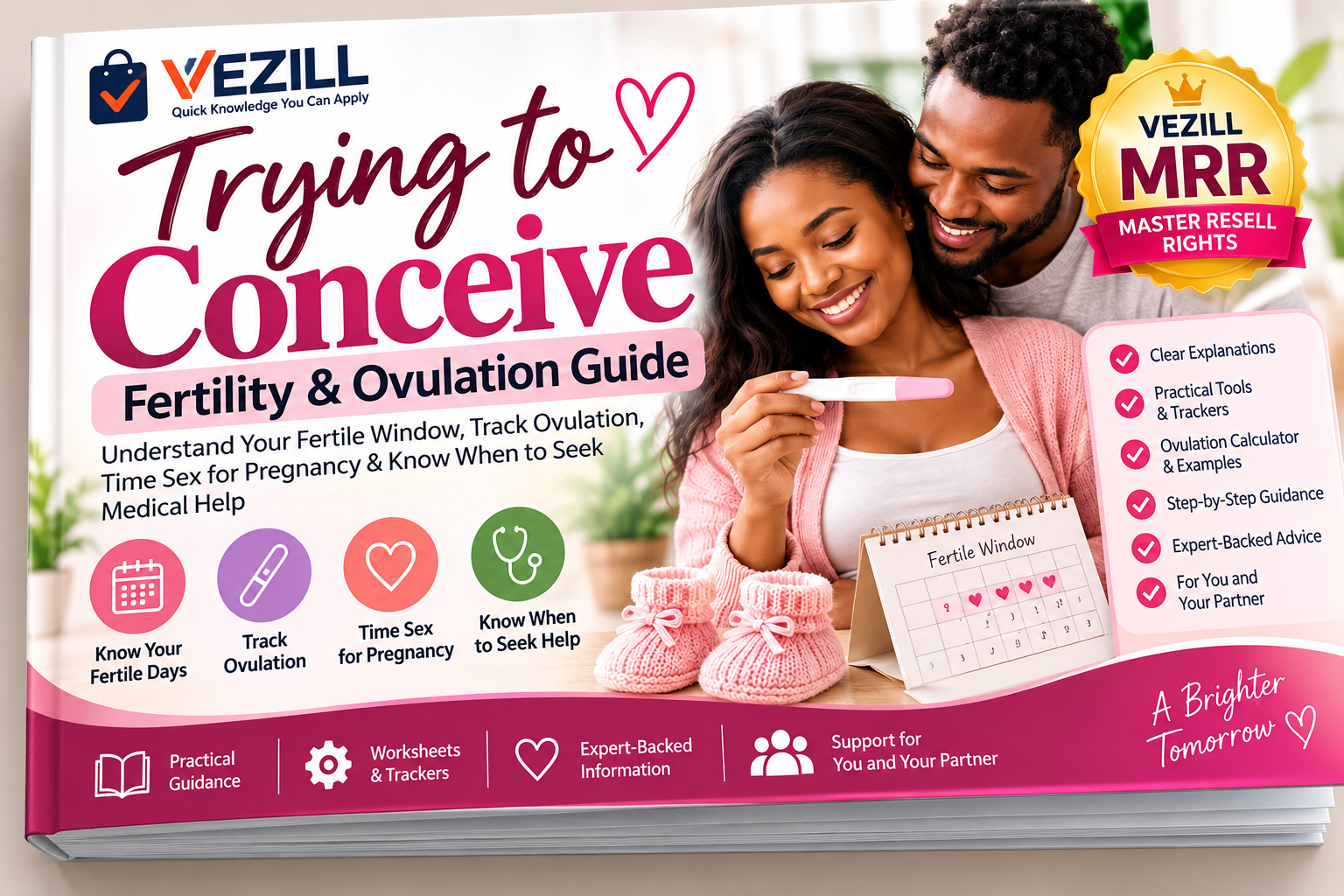
Trying to Conceive: Fertility & Ovulation Guide is a practical, easy-to-follow fertility guide designed to help you understand your menstrual cycle, estimate your fertile window, recognize signs of ovulation and make more informed decisions while trying for a baby.
If you've been searching:
“When am I most fertile?”
“How do I calculate my fertile days?”
“How do I know when I'm ovulating?”
“When is the best time to have sex to get pregnant?”
“How do ovulation tests work?”
“Why am I not pregnant yet?”
“When should I see a fertility doctor?”
…this guide brings those questions together into one practical system you can actually follow.
You download an ovulation app.
It gives you a date.
Another calculator gives you a different date.
Then you start noticing changes in discharge and wonder whether you're ovulating.
You buy an ovulation test but aren't completely sure what the result means.
Your period arrives again.
And suddenly you're asking yourself:
Did we try on the wrong days?
Did I actually ovulate?
Am I calculating my cycle correctly?
Should we be trying every day?
Is something wrong?
Trying to conceive can easily turn from something exciting into a cycle of guessing, searching, calculating and worrying.
This guide was created to give you something much more useful:
Instead of relying on random internet advice or assuming everyone ovulates on Day 14, this guide teaches you how fertility timing actually works.
You'll learn how to use your cycle history to estimate your fertile window — while understanding why calendar calculations are only estimates.
You'll also learn how other fertility signs can provide additional information, including:
✓ Cervical mucus changes
✓ Ovulation predictor kits (OPKs)
✓ LH surge
✓ Basal body temperature (BBT)
✓ Menstrual-cycle patterns
✓ Common physical signs associated with ovulation
Most importantly, you'll learn how to put the information together without expecting any single symptom, app or calculator to predict ovulation perfectly.
One of the biggest misconceptions when trying to conceive is that there is only one day each month when pregnancy can occur.
The fertile window actually extends across several days around ovulation.
That matters because sperm may remain capable of fertilization for several days, while the egg has a much shorter opportunity after ovulation.
The guide helps you understand this window and identify the days when trying for pregnancy generally makes the most sense.
Your cycle may be 26 days.
Or 28.
Or 30.
Or 32.
Or 35.
And your ovulation timing may be different from someone else's.
The guide walks you through examples for different cycle lengths so you can understand the calculation rather than simply receiving a date from an app.
Understand Cycle Day 1, the follicular phase, ovulation and the luteal phase in simple language.
Learn how cycle length can be used to create a practical fertile-window estimate.
See worked examples using different cycle lengths and then complete your own ovulation estimator.
Learn what cervical mucus, LH changes, basal body temperature and other possible signs may tell you.
Understand what an OPK measures, what a positive result means and the common mistakes to avoid.
Understand the typical progression from:
Dry/Sticky → Creamy → Watery → Slippery/Stretchy
…and what those changes may mean for fertility.
Learn how BBT can help you identify patterns and why it is generally more useful for confirming an ovulatory shift than predicting today's fertility.
Understand practical intercourse timing during the fertile window without turning intimacy into a stressful daily assignment.
Use a simple relative-day plan around estimated ovulation.
Learn about folic acid, medicines, smoking, alcohol, nutrition, physical activity, chronic health conditions and other considerations before pregnancy.
Fertility isn't only a woman's issue.
The guide explains common male fertility considerations and why evaluating both partners can be important.
Learn why ordinary calendar calculators become less reliable when cycles are irregular and when irregular or absent periods deserve medical attention.
Understand how age relates to fertility without fear-based messaging or assumptions about your individual fertility.
Understand why not conceiving immediately does not automatically mean infertility — and which questions require proper medical evaluation.
Get a straightforward explanation of when fertility evaluation is generally recommended and which circumstances may justify seeking advice sooner.
Understand the possible role of medical history, ovulation assessment, semen analysis, blood tests, imaging and fallopian-tube assessment.
This isn't designed as a fertility textbook that you read once and forget.
It's a practical companion.
You'll receive:
✓ My Cycle at a Glance Worksheet
✓ Fertile Window Quick Reference
✓ Ovulation Estimator
✓ OPK Testing Example
✓ 30-Day BBT Tracker
✓ Cervical Mucus Reference
✓ 7-Day TTC Timing Plan
✓ Preconception Checklist
✓ 3-Cycle Trying-to-Conceive Action Plan
✓ Printable TTC Cycle Tracker
✓ Quick Fertility Decision Guide
✓ 20+ Frequently Asked Fertility Questions
✓ One-Page TTC Quick Start Plan
The guide gives you a structured approach instead of asking you to track everything at once.
Understand your period dates, cycle length, cervical mucus and estimated fertile window.
If useful, introduce an ovulation predictor kit and improve how you identify your fertile days.
Compare your cycle patterns, ovulation estimates, OPK results and intercourse timing.
Then decide what makes sense next.
Important: the three-cycle system isn't a requirement to delay medical care. If your age, symptoms, medical history or time already spent trying indicates that you should seek professional advice, the guide explains when to do so.
Should you lie down after sex?
Do you have to try on Day 14?
Does a particular sexual position increase your chances?
Can one special food boost fertility?
Does having regular periods guarantee fertility?
Can an app tell you exactly when you're ovulating?
The guide separates common fertility myths from evidence-based information so you can focus on useful actions rather than internet folklore.
This guide may be especially useful if:
✓ You've recently started trying for a baby.
✓ You're confused about fertile days.
✓ You don't know how to calculate ovulation.
✓ Your fertility app leaves you with more questions.
✓ You want to understand ovulation symptoms.
✓ You're considering using an OPK.
✓ You want to know when intercourse should be timed.
✓ You're worried because pregnancy hasn't happened yet.
✓ You want to understand when professional fertility help may be appropriate.
✓ You want your partner involved in the process.
There is no guide, supplement, food or ovulation calculator that can guarantee pregnancy.
Trying to Conceive: Fertility & Ovulation Guide takes a different approach:
Understand → Track → Time → Review → Know When to Get Help
Because the goal isn't to promise pregnancy.
The goal is to help you make better-informed decisions while trying to conceive.
The guide shows you a simple cycle-length method for estimating ovulation and your fertile window, with worked examples for several cycle lengths. Because ovulation can shift, the dates are clearly presented as estimates.
No. Day 14 is commonly used as an example for a 28-day cycle, but actual ovulation timing varies between people and between cycles.
The guide covers cervical mucus changes, LH surge detected by OPKs, basal body temperature patterns and other possible physical signs.
The guide explains how to use regular intercourse during the fertile window without creating an unnecessarily rigid schedule.
Calendar estimates become less reliable with irregular cycles. The guide explains this limitation and when irregular or absent periods should be discussed with a healthcare professional.
The guide explains the commonly used age- and time-based thresholds and circumstances in which earlier assessment may be appropriate.
Don't only learn from this digital product.
Depending on the specific VEZILL licence supplied with your purchase, you may also be able to resell the product and earn from your sales.
The MRR opportunity is designed for:
✓ Digital product resellers
✓ Affiliate and online marketers
✓ Content creators
✓ Social-media marketers
✓ WhatsApp sellers
✓ TikTok and Reels creators
✓ Bloggers and niche publishers
✓ People building a digital-products business
1. BUY
Purchase the qualifying digital product.
2. LEARN
Understand the product and the audience it helps.
3. RESELL
Where permitted by the accompanying MRR licence, promote and resell the product.
4. EARN
Receive the applicable reseller share from eligible sales according to current VEZILL terms.
Personal Value:
Learn how fertility timing and ovulation tracking work.
Business Value:
Where the included licence permits, sell the guide to people looking for the same practical information.
Always review the specific MRR licence and current VEZILL reseller terms supplied with the product before reselling.
Trying for a baby already carries enough emotion.
Understanding your fertile window shouldn't have to feel complicated.
Get a practical guide that helps you answer:
When am I likely to be fertile?
What signs should I watch for?
When should we try?
What can an ovulation test tell me?
What if my cycles are irregular?
When should we ask for medical help?
Understand Your Cycle → Track Ovulation → Identify Your Fertile Window → Time Intercourse → Know Your Next Step
Trying to Conceive: Fertility & Ovulation Guide
Practical Tools • Cycle Trackers • Ovulation Guidance • Fertile Window Examples • TTC Action Plan • MRR Opportunity
Important Medical Disclaimer: This digital guide provides general educational information and is not medical advice, diagnosis or treatment. It does not guarantee conception or pregnancy. Individual fertility circumstances vary. Consult an appropriately qualified healthcare professional for personalized fertility or reproductive-health advice.
Get the updates, on newly released, popular & fast-moving MRR digital products
Up to Top
Comments