
Ellan
Joined - December 2025

Don't choose a course simply because it sounds prestigious, your friends are taking it, or someone told you it is “marketable.”
Your course choice could influence the next several years of your education, career and finances.
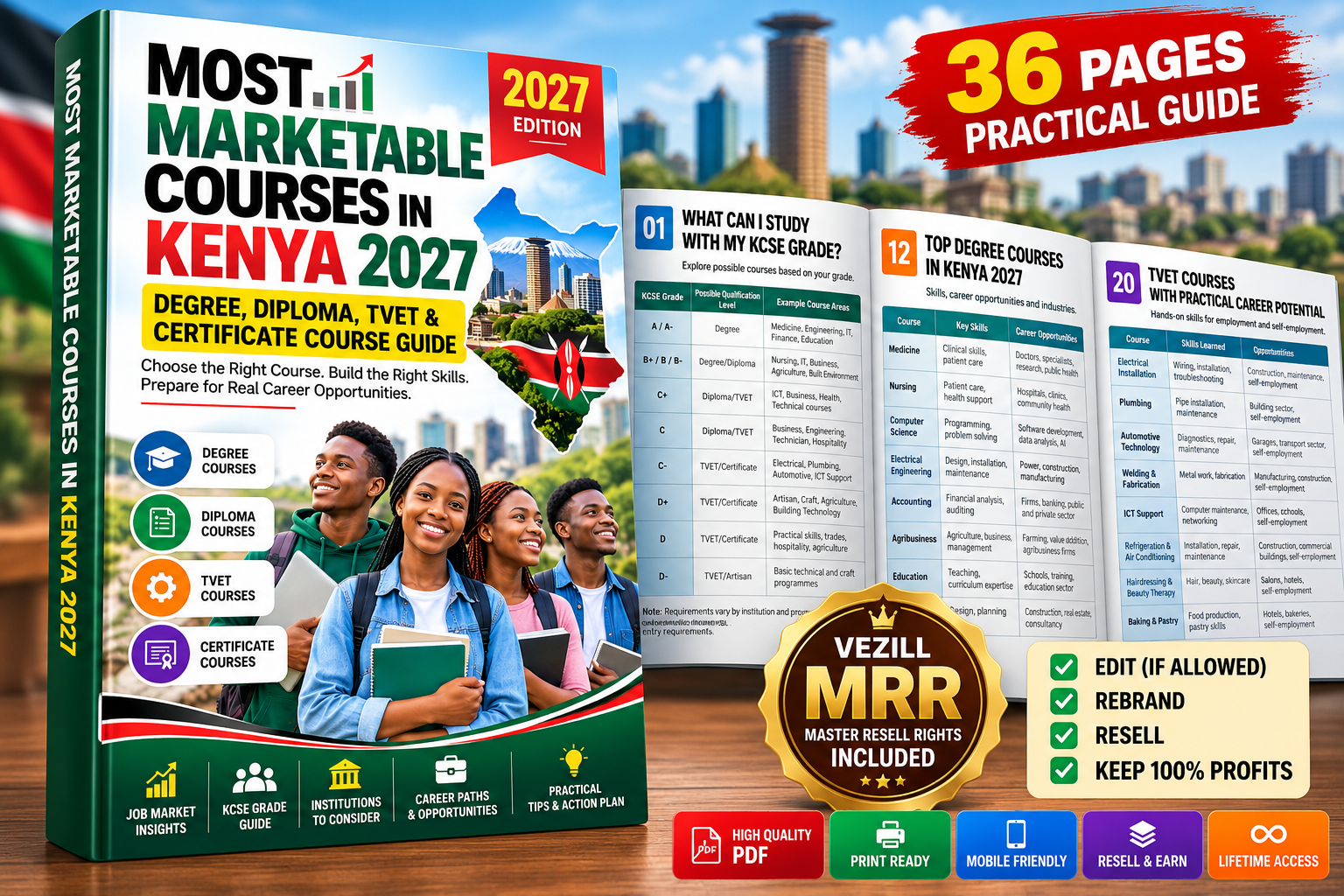
The Most Marketable Courses in Kenya 2027 Guide is a practical 36-page course-selection playbook designed to help Kenyan students and parents compare Degree, Diploma, TVET, Certificate and Artisan pathways before making that important decision.
Whether you scored A, B, C+, C, C-, D+, D or D-, this guide helps you understand the pathways worth investigating based on your grade, interests, practical skills and career goals.
This is the question thousands of students and parents face after KCSE.
You may be wondering:
What are the most marketable courses in Kenya in 2027?
Which course can I do with my KCSE grade?
Which degree courses have good career opportunities?
Which diploma courses are worth considering?
What are the best TVET courses in Kenya?
Which certificate courses can lead to practical skills?
Should I choose university or TVET?
Degree or diploma—which is better for my career?
Which courses can lead to self-employment?
Which skills could allow me to work online?
Which careers may offer international opportunities?
Will AI affect the career I'm considering?
This guide was created to help you work through these questions systematically.
Many online articles simply give you a list:
Medicine
Engineering
Computer Science
Nursing
Business...
But that doesn't answer the most important question:
A course can be popular and still be wrong for your:
KCSE grade
subject performance
interests
abilities
budget
preferred type of work
career plans
entrepreneurship goals
That's why this guide takes a different approach.
↓
↓
↓
↓
↓
↓
Instead of simply asking:
“Which course is marketable?”
you'll learn to ask:
“Which recognised course fits my grades and abilities, develops useful skills and gives me realistic employment, business or progression opportunities?”
Quickly explore possible pathways for:
A / A-
B+ / B / B-
C+
C
C-
D+
D
D-
See possible qualification levels, course areas, career directions and progression opportunities.
You'll also learn why mean grade alone doesn't automatically qualify you for every course.
Explore major university fields including:
Computer Science
Software Engineering
Cybersecurity
Information Technology
Data Science
Artificial Intelligence
Nursing
Medicine and health sciences
Pharmacy
Engineering
Quantity Surveying
Architecture and Built Environment
Accounting
Finance
Supply Chain Management
Agribusiness
Food Science
Education
Digital Marketing
Hospitality and Tourism
Instead of simply listing course names, the guide helps you think about:
Course → Skills → Career Direction → Additional Skills
A degree isn't the only route to a successful career.
Discover diploma pathways that can help you develop practical and professional skills.
Learn how to evaluate:
→ Skill Learned
→ Potential Jobs
→ Self-Employment Opportunities
→ Progression to Higher Levels
This section is especially useful for students comparing Degree vs Diploma options.
Technical and vocational education can be a powerful option for students who prefer practical skills.
Explore areas such as:
Electrical Installation
Plumbing
Welding & Fabrication
Automotive Technology
Motor Vehicle Diagnostics
Refrigeration & Air Conditioning
Solar Installation
Building Technology
Masonry
Carpentry
ICT Support
Electronics Repair
Fashion Design
Hairdressing & Beauty
Food Production
Baking & Pastry
Agribusiness
Hospitality
You'll see how to think about both:
and
Didn't qualify for direct university entry?
That does not mean your education journey is over.
Discover how recognised pathways may allow progression such as:
↓
↓
↓
Exact progression depends on the programme and institution, so the guide also shows you what to verify before enrolling.
Instead of choosing based only on course names, start with your goal.
The guide helps you explore options if you want to:
This makes course selection much easier.
Compare:
Learning approach
Practical exposure
Duration
Qualification pathways
Career routes
Entrepreneurship opportunities
Progression
The guide doesn't tell every student that university is better.
And it doesn't tell every student that TVET is better.
Instead, it helps you decide based on:
Your intended occupation + qualifications + finances + learning style + career goals.
Should you pursue a degree?
Or would a diploma provide a more practical starting point?
Compare:
Entry Requirements
Study Duration
Practical Training
Career Goals
Professional Requirements
Progression
Cost Considerations
Make the decision based on your intended career—not social pressure.
One of the most important lessons in this guide:
For example:
Don't stop with the degree.
Add:
Software Projects
GitHub Portfolio
AI Tools
Cloud Skills
Cybersecurity
Internship Experience
Add:
Professional Certification
Excel
Accounting Software
Data Analytics
Tax Knowledge
Add:
Solar Installation
Industrial Controls
Troubleshooting
Safety Skills
Practical Projects
Add:
Digital Advertising
Analytics
Copywriting
CRM
Sales
The goal is simple:
Worried that AI might replace your future career?
The better question is:
“How can I become the professional who knows how to use AI effectively in this career?”
Discover how AI is changing:
Programming
Accounting
Marketing
Design
Engineering
Healthcare
Education
Administration
Customer Service
Data Analysis
And learn how to prepare yourself for an increasingly AI-assisted workplace.
Before paying college or university fees, you need to know:
Is the institution recognised?
Is the programme recognised?
Who awards the qualification?
Does the profession require registration?
Can the qualification allow progression?
The guide shows you where to verify information through relevant bodies such as:
KUCCPS
Commission for University Education
TVET Authority
Kenya National Qualifications Authority
Relevant professional regulators
Don't simply believe someone who says:
“This course has jobs.”
Test it yourself.
The guide gives you a simple system to investigate:
Search current vacancies.
Look at genuine job openings.
Study the skills employers request.
Investigate internship opportunities.
Check self-employment possibilities.
Check licensing requirements.
Research people already working in the profession.
Check qualification progression.
Verify accreditation.
Compare training cost against realistic career possibilities.
Now you're choosing based on evidence, not rumours.
Still stuck between several courses?
Score each option based on:
✓ Personal Interest
✓ Academic Fit
✓ Employment Demand
✓ Practical Skills
✓ Self-Employment Potential
✓ International Portability
✓ Online/Remote Potential
✓ Affordability
✓ Study Duration
✓ Career Progression
✓ Professional Recognition
✓ Internship Opportunities
Then calculate your:
A simple worksheet can turn confusion into a structured decision.
Use the included comparison worksheet to put your three strongest options side by side.
Compare:
| Compare | Course 1 | Course 2 | Course 3 |
|---|---|---|---|
| Qualification | ✓ | ✓ | ✓ |
| Entry Requirements | ✓ | ✓ | ✓ |
| Institution | ✓ | ✓ | ✓ |
| Duration | ✓ | ✓ | ✓ |
| Cost | ✓ | ✓ | ✓ |
| Skills | ✓ | ✓ | ✓ |
| Career Options | ✓ | ✓ | ✓ |
| Self-Employment | ✓ | ✓ | ✓ |
| Progression | ✓ | ✓ | ✓ |
| Accreditation | ✓ | ✓ | ✓ |
Then make a more informed choice.
❌ Your friends chose it.
❌ Your relatives told you to take it.
❌ The title sounds prestigious.
❌ Someone claims graduates make huge salaries.
❌ An institution calls it “100% marketable.”
❌ TikTok says it is the highest-paying course.
❌ You assume every degree automatically leads to employment.
❌ You haven't checked accreditation.
❌ You don't know what graduates actually do.
The guide gives you a ready-to-use checklist including:
□ Is the institution accredited?
□ Is the programme recognised?
□ Who awards/examines the qualification?
□ What are the exact entry requirements?
□ Are there practical facilities?
□ Is industrial attachment included?
□ What is the total estimated cost?
□ Are there additional examination charges?
□ Is professional registration required?
□ Can I progress to another qualification?
These questions could save you from making an expensive mistake.
You don't have to spend months confused about what to study.
Follow the included action plan:
Analyse your KCSE results and strongest subjects.
Identify three career areas that interest you.
Find courses connected to those careers.
Research career and self-employment opportunities.
Check requirements and accreditation.
Compare institutions, costs and progression.
Select your three strongest realistic options.
Then write down:
This guide is especially useful for:
You're getting a practical 36-page decision system designed to help you:
Courses that match your qualifications.
Degree, Diploma, TVET and Certificate pathways.
Requirements, institutions and accreditation.
A realistic course based on evidence.
For practical competence.
Beyond the classroom.
Through employment, entrepreneurship or further education.
This guide includes Vezill Master Resell Rights (MRR).
That means your purchase can potentially become more than a learning resource.
After reading and understanding the guide, you can also sell authorised copies under the included Vezill MRR terms.
1. BUY THE GUIDE
Get your copy of Most Marketable Courses in Kenya 2027.
↓
2. USE IT
Learn how to research and compare courses.
↓
3. SHARE THE KNOWLEDGE
Recommend the guide to students, parents, KCSE candidates and people choosing colleges.
↓
4. RESELL
Sell this guide through Vezill by sharing your unique reseller link- keep 90% of sale profit.
↓
5. EARN FROM USEFUL KNOWLEDGE
Turn a practical education resource into a digital-product opportunity.
KCSE candidates
Parents
Students
Career guidance communities
Education-focused WhatsApp groups
Digital marketers
Content creators
Campus communities
Important: Reselling is subject to the specific Vezill MRR licence and marketplace terms supplied with the product. Income is not guaranteed and depends on your marketing, pricing and sales.
Before choosing based on hype...
Before paying college fees...
Before applying simply because your friends applied...
Before deciding that only university can lead to success...
Use the worksheets.
Compare your options.
Check accreditation.
Understand the skills.
Then make your decision.
36-Page Practical Course & Career Decision Guide
FIND → COMPARE → VERIFY → CHOOSE → TRAIN → BUILD SKILLS → GET EXPERIENCE → CREATE OPPORTUNITIES
This guide provides practical educational and career-planning information. Course requirements, KUCCPS placement criteria, fees, programme availability, accreditation and professional requirements can change.
Always verify current information with the relevant institution, KUCCPS, CUE, TVETA, KNQA or applicable professional regulator before applying or paying fees.
Get the updates, on newly released, popular & fast-moving MRR digital products
Up to Top


Comments