
Ellan
Joined - December 2025

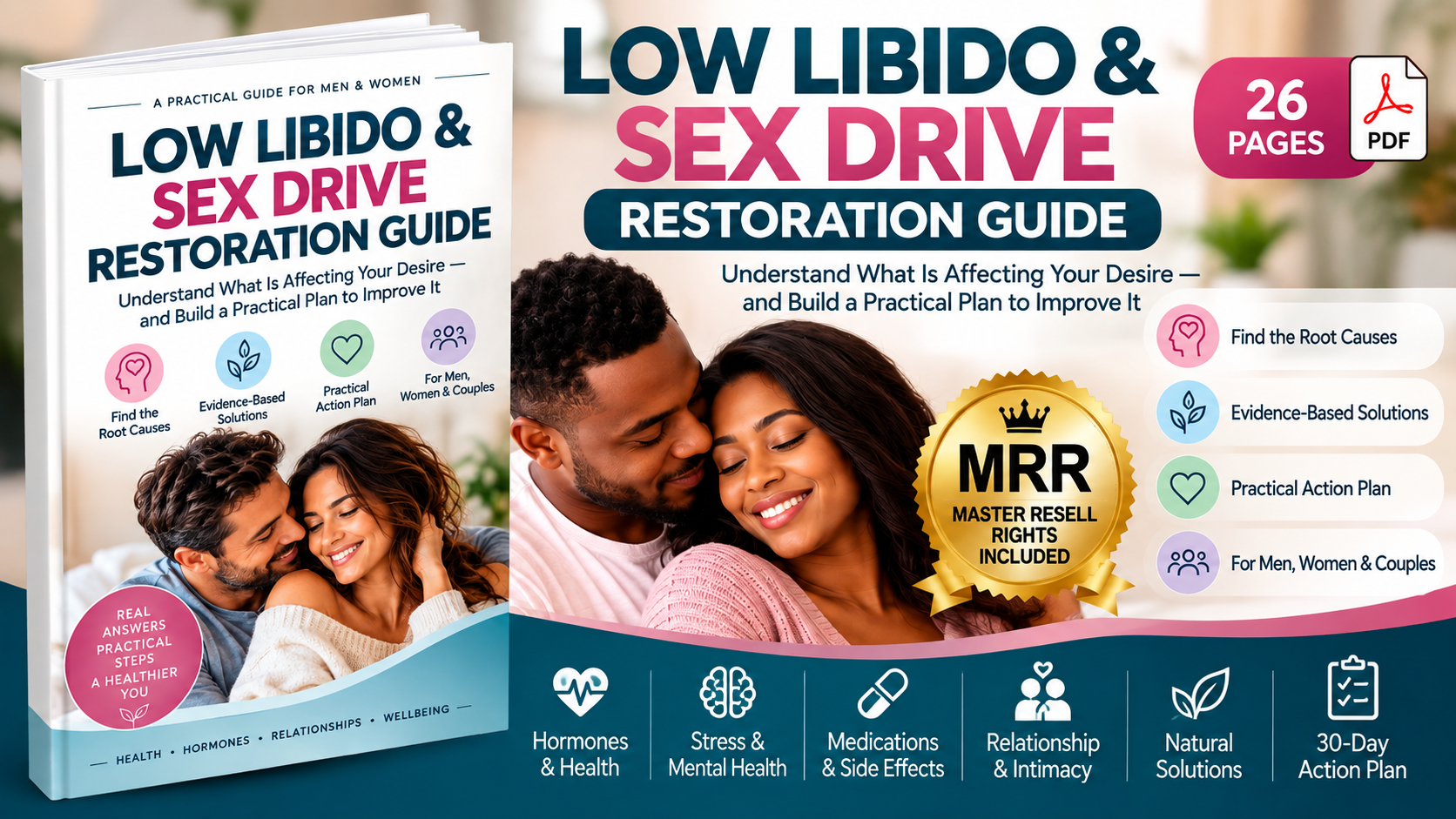
Understand what may be affecting your desire, identify possible causes, and build a practical plan for improving your sexual wellbeing.
For Men • Women • Couples
26-Page Practical PDF Guide | Instant Digital Access | Master Resell Rights (MRR) Included
Maybe you used to feel desire naturally - but lately, something feels different.
Perhaps you’re searching for answers to questions like:
Why is my sex drive low?
How can I increase my libido?
Why don't I want sex anymore?
How can I get my sex drive back?
What causes low libido in women?
What causes low libido in men?
Could stress be killing my sex drive?
Could my medication be affecting my libido?
Is my low sex drive caused by hormones?
Could low testosterone be responsible?
Why am I always tired and have no interest in sex?
Why do I love my partner but don't feel like having sex?
Does menopause affect libido?
What foods or supplements actually increase libido?
Low sexual desire can be confusing.
It can make you question your body, your hormones, your health and sometimes even your relationship.
But there isn't one single cause of low libido.
And that means randomly buying a “libido booster” may not address what is actually affecting you.
The Low Libido & Sex Drive Restoration Guide gives you a practical framework for investigating the factors that may be suppressing desire — and deciding what to do next.
Sexual desire can be influenced by many interconnected factors, including:
Physical health • Hormones • Medications • Sleep • Stress • Mental health • Sexual function • Relationship dynamics • Lifestyle
This guide walks you through these areas one by one.
Instead of promising a miracle cure, it helps you ask a much more useful question:
That question can help you begin identifying the real issue.
Understand what libido actually is and why sexual desire naturally changes over time.
Learn the difference between:
Sexual desire
Physical arousal
Erections
Lubrication
Orgasm
Spontaneous desire
Responsive desire
You'll also complete a practical self-check to identify what changed around the time your libido changed.
Instead of guessing, investigate seven important areas:
1. Physical health
2. Hormones
3. Medications
4. Sleep & lifestyle
5. Psychological and emotional health
6. Sexual function
7. Relationship and context
You'll learn how several factors can overlap — and why your solution may involve more than one area.
The guide explains how general health can influence libido and sexual function.
Learn about possible connections involving:
Diabetes
Cardiovascular health
Chronic illness
Chronic pain
Thyroid problems
Fatigue
Sleep disorders
Obstructive sleep apnea
Metabolic health
Recovery from illness or surgery
Most importantly, you'll learn when a change in sexual desire may be worth discussing with a healthcare professional.
Low libido does not automatically mean low testosterone.
The guide helps you understand the potential role of:
Testosterone
Estrogen
Thyroid hormones
Prolactin
Pregnancy
Postpartum changes
Breastfeeding
Perimenopause
Menopause
You'll also learn why self-prescribing testosterone, estrogen or other hormonal products is not a safe shortcut.
The dedicated men's section explores common contributors such as:
Stress
Fatigue
Poor sleep
Depression and anxiety
Medication effects
Alcohol and substance use
Chronic illness
Low testosterone and other endocrine issues
Erectile difficulties
Performance anxiety
Relationship difficulties
Aging
These problems are often confused.
The guide explains why wanting sex and being physically able to achieve or maintain an erection are related but not the same thing.
You'll also get a simple decision pathway for determining what deserves further attention.
Explore potential contributors including:
Pregnancy
Postpartum recovery
Breastfeeding
Perimenopause
Menopause
Vaginal dryness
Pain during sex
Fatigue
Body-image concerns
Stress
Mental health
Medication
Hormonal contraception
Relationship factors
If sex becomes uncomfortable, your body and brain may begin anticipating that discomfort.
The guide explains why treating pain or dryness may be more useful than simply trying to “increase libido.”
Some medications can affect sexual desire or sexual function in some people.
Inside, you'll learn about medication categories that may sometimes contribute, including certain:
Antidepressants
Blood-pressure medicines
Hormonal treatments or contraception
Other medicines affecting sexual function
You'll also receive a simple conversation starter you can take to your healthcare professional.
Never stop, reduce or change prescription medication simply because you suspect it is affecting your libido.
The guide shows you how to raise the concern safely with the prescribing clinician.
Sometimes the problem isn't that your body has “stopped working.”
Your mental load may simply be overwhelming your capacity for desire.
Discover how sexual interest can be affected by:
Chronic stress
Anxiety
Depression
Burnout
Financial pressure
Parenting
Caregiving
Grief
Poor sleep
Relationship conflict
Performance pressure
Then learn practical ways to improve the conditions that support healthy desire.
This is one of the most emotionally difficult questions people ask about low libido.
Low sexual desire does not automatically mean you've stopped loving your partner.
Inside the guide, explore:
Emotional disconnection
Unresolved conflict
Resentment
Routine
Lack of privacy
Mismatched sex drives
Poor communication
Sexual dissatisfaction
Performance pressure
Trust issues
Feeling pressured to have sex
Get a practical framework for discussing reduced desire without turning the conversation into accusation, rejection or blame.
Sexual problems themselves can sometimes reduce desire.
The guide explains the cycle:
Sexual Difficulty → Worry → Performance Pressure → Avoidance → Lower Desire → More Worry
Learn how desire may be affected by:
Erectile difficulties
Premature ejaculation
Difficulty reaching orgasm
Vaginal dryness
Painful intercourse
Pelvic discomfort
Performance anxiety
Fear of sexual failure
Sometimes improving the underlying sexual difficulty is more useful than trying to “boost” desire directly.
You'll get practical guidance covering:
Understand why consistently poor sleep can affect energy, mood and sexual wellbeing.
Learn how regular physical activity supports general health, energy and mood.
Use realistic strategies instead of simply being told to “relax.”
Understand why excessive alcohol may interfere with sexual response.
Focus on balanced nutrition instead of miracle aphrodisiac claims.
Learn how to rebuild affection and closeness without turning every interaction into pressure for sex.
Become more comfortable discussing preferences, concerns and boundaries.
Learn when pain, dryness, erectile difficulties or other sexual problems deserve proper attention.
Before spending money on another supplement promising incredible results, understand what the evidence actually says.
The guide examines commonly searched options such as:
Maca
Ginseng
Tribulus
Fenugreek
Ashwagandha
Natural testosterone boosters
Men's libido pills
Women's libido supplements
Aphrodisiac foods
You'll learn to evaluate them using five questions:
What is the evidence?
What remains uncertain?
What are the possible risks?
Could it interact with medication?
Is the claim primarily marketing?
Because “natural” doesn't automatically mean safe or effective.
Get a straightforward overview of the treatment categories healthcare professionals may consider depending on the underlying problem.
These may include:
Treating underlying health conditions
Medication review
Psychological therapy
Sex therapy
Couples therapy
Managing vaginal dryness or pain
Menopause-related treatment
Appropriate hormone evaluation
Testosterone treatment for appropriately diagnosed men
Selected treatments for female sexual-interest/arousal problems
You'll understand the options without being encouraged to self-diagnose or self-prescribe.
The guide explains why there is no universal “low libido blood test panel.”
You'll learn what a clinician may consider based on your symptoms, including:
Medical and sexual history
Medication review
Physical examination when appropriate
Testosterone evaluation in appropriate male patients
Thyroid testing
Diabetes/glucose assessment
Other targeted tests
This can help you walk into an appointment better prepared.
Learn which situations deserve medical attention, including:
✓ Sudden unexplained loss of libido
✓ Persistent symptoms causing distress
✓ Significant fatigue or other unexplained symptoms
✓ Pain during sex
✓ Persistent erectile difficulties
✓ Possible hormonal symptoms
✓ Significant depression or anxiety
✓ Symptoms beginning after medication changes
✓ Sexual symptoms accompanying another health problem
✓ Menopause symptoms affecting quality of life
Stop wondering:
“What am I supposed to tell the doctor?”
Use the included checklist to organize:
When the problem started
Whether it was sudden or gradual
Current medications and supplements
Sleep quality
Stress
Alcohol/substance use
Other symptoms
Menstrual or menopause status where relevant
Pregnancy/postpartum/breastfeeding status where relevant
Erectile or sexual-function symptoms
Pain
Relationship/context changes
Relevant medical conditions
Plus 10 useful questions to ask your healthcare professional.
You don't need another vague list of “libido tips.”
You need a process.
Identify what may be suppressing desire.
Review your:
Libido • Medication • Sleep • Stress • Health • Mood • Sexual comfort • Relationship
Focus on:
Sleep • Movement • Nutrition • Stress • Energy • Alcohol reduction where appropriate
Work on:
Communication • Affection • Quality time • Non-demand intimacy • Sexual communication • Reducing performance pressure
Ask:
What improved?
What didn't?
What patterns appeared?
Do I need professional assessment?
What should I discuss with my clinician?
The objective is to understand and improve the conditions that support healthy desire.
Score and review:
✓ Physical health
✓ Energy & fatigue
✓ Sleep
✓ Stress
✓ Mood
✓ Medication changes
✓ Hormonal/life-stage changes
✓ Sexual comfort
✓ Relationship connection
✓ Performance anxiety
✓ Lifestyle factors
Then identify your:
and create your:
Get clear answers to common misconceptions, including:
“Low libido always means low testosterone.”
“If my partner doesn't want sex, they don't love me.”
“Men should always want sex.”
“Women naturally lose interest in sex.”
“Libido supplements fix low desire.”
“Alcohol improves sexual performance.”
“More testosterone means better sex.”
“Young people can't experience medically related low libido.”
Get straightforward answers to high-intent questions such as:
Why is my sex drive suddenly low?
How can I increase my libido naturally?
What causes low libido in women?
What causes low libido in men?
Can stress kill my sex drive?
Can lack of sleep reduce libido?
Does testosterone increase sex drive?
Can antidepressants lower libido?
Does menopause cause low libido?
Why do I love my partner but not want sex?
What foods increase libido?
Do libido supplements work?
When should I see a doctor?
Can low libido be treated?
This practical guide may be especially useful if you:
✓ Have noticed your sexual desire has dropped
✓ Keep searching “why is my sex drive low?”
✓ Want to understand how to increase libido safely
✓ Feel tired, stressed or mentally overloaded
✓ Are worried hormones may be involved
✓ Think medication could be affecting your sex drive
✓ Are experiencing menopause, postpartum or other life-stage changes
✓ Experience erectile difficulties, dryness, pain or performance anxiety
✓ Love your partner but don't feel as interested in sex
✓ Want to improve communication and intimacy
✓ Are considering libido supplements but want to understand the evidence first
✓ Want to know when professional assessment is appropriate
Read the guide privately.
Complete the self-assessments.
Identify possible contributors.
Follow the practical action plan.
Prepare better questions for your healthcare professional.
Your purchase includes Vezill Master Resell Rights (MRR) for this digital product, subject to the applicable Vezill product licence terms.
That means this isn't only knowledge you can use.
It can also become a digital product you promote and resell under the permitted licence terms and keep 90% of your qualifying sales revenue.
BUY → LEARN → SHARE → SELL → EARN
Instead of creating a complete digital guide from scratch, you receive an existing digital knowledge product that you can market according to its MRR licence.
Possible promotion channels include:
WhatsApp Status
TikTok
Reels
Short educational videos
Health/wellness content
Relationship content
Email audiences
Relevant online communities, subject to their rules
MRR gives you resale rights according to the product's applicable licence. It does not guarantee sales, income or profit. Your results depend on factors including audience, pricing, marketing, demand and execution.
Understand what may be affecting your desire and what practical next steps make sense.
Use the included Vezill MRR opportunity according to the licence terms.
You don't need another article telling you to:
“Eat this food.”
“Take this supplement.”
or
“Just relax.”
You need to understand the bigger picture.
Your sex drive can be influenced by your:
BODY + HORMONES + MEDICATION + SLEEP + MIND + SEXUAL FUNCTION + RELATIONSHIP
And once you understand which areas may be affecting you, your next steps become much clearer.
26-Page Practical Digital Guide
✓ Instant PDF access
✓ For men and women
✓ Evidence-informed explanations
✓ Practical self-assessments
✓ Male & female libido sections
✓ Hormone explanations
✓ Medication guidance
✓ Relationship & intimacy strategies
✓ Supplement fact-checking
✓ Doctor-visit checklist
✓ 30-day action plan
✓ Personal worksheet
✓ 20 FAQs
✓ Vezill Master Resell Rights included
Understand What's Affecting Your Desire. Take Practical Steps. Make Better-Informed Decisions.
This guide provides general educational information only. It does not diagnose or treat medical conditions and is not a substitute for individualized advice, diagnosis or treatment from a qualified healthcare professional.
Do not stop prescription medication or begin hormone treatment based solely on information in this guide. Seek appropriate professional care for persistent, distressing, sudden or medically concerning symptoms.
Get the updates, on newly released, popular & fast-moving MRR digital products
Up to Top
Comments