
Ellan
Joined - December 2025

Want to apply for an affordable house in Kenya but aren't sure where to start?
Maybe you've heard about Boma Yangu, Affordable Housing, the Housing Levy, voluntary savings, deposits and Tenant Purchase Scheme (TPS) - but you're still wondering:
How do I actually apply for a house?
This practical guide brings the process together in one simple, beginner-friendly resource.
Instead of searching through different websites, regulations, FAQs and online explanations, use this guide to understand the journey from:
REGISTER → SAVE → SELECT A HOME → APPLY → ALLOCATION → FINANCE → OWN
Many prospective applicants have the same questions:
Who qualifies for affordable housing in Kenya?
How do I register on Boma Yangu?
Is Boma Yangu registration free?
Can I apply using my phone?
What does paying the Housing Levy mean for my application?
How do Boma Yangu savings work?
How much deposit do I need?
How do I find available affordable housing projects?
Can I choose the house or location I want?
How does affordable housing allocation work?
What happens if my application is unsuccessful?
Can I use a mortgage?
What is the Tenant Purchase Scheme?
Can self-employed Kenyans apply?
Can Kenyans in the diaspora apply?
How do I avoid fake Boma Yangu agents and scams?
This guide was designed to answer those questions in plain language — and show you what to do next.
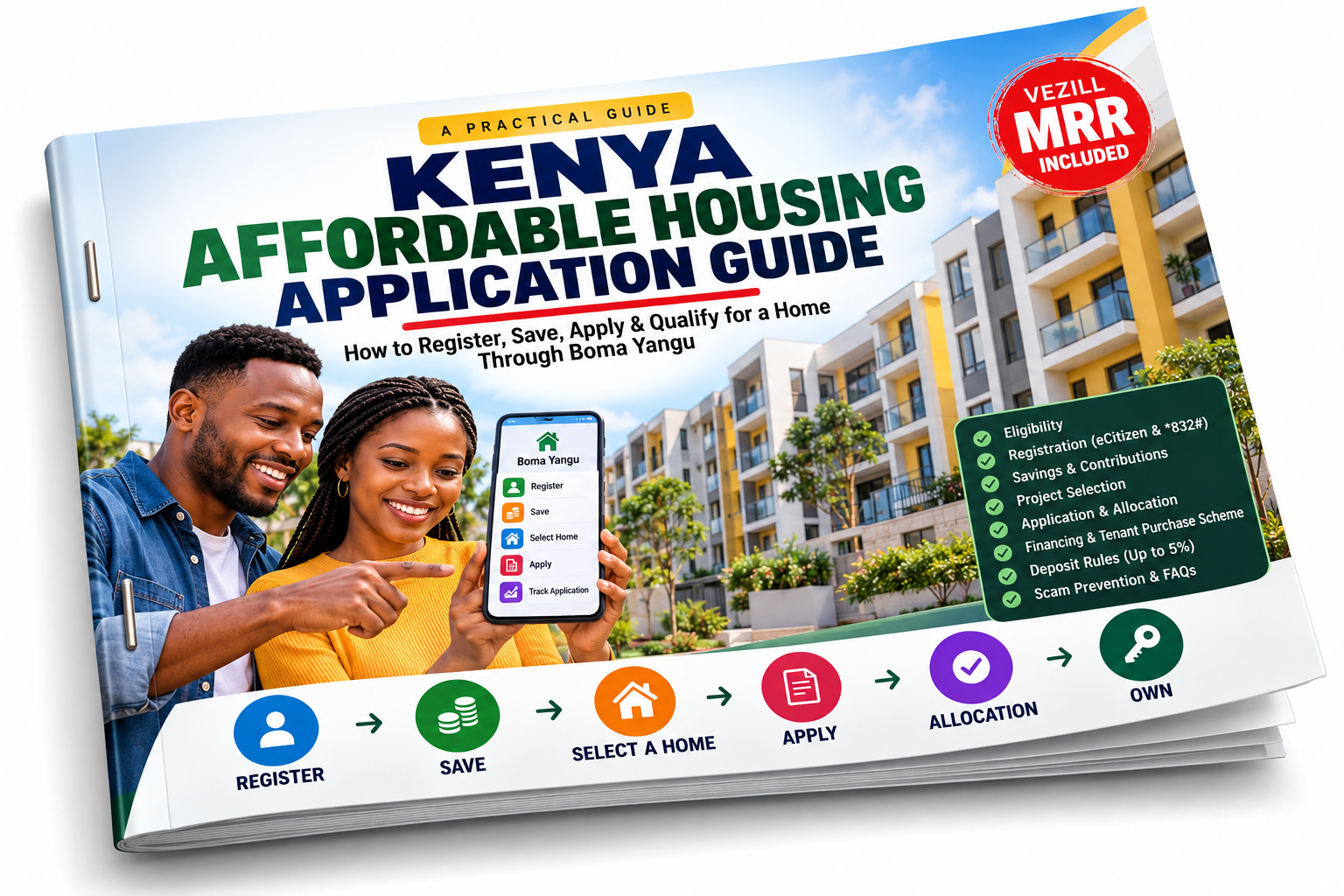
The Kenya Affordable Housing Application Guide is a practical step-by-step manual for Kenyans who want to understand and navigate the Affordable Housing application process.
It explains the process from preparing for registration through savings, project selection, application and allocation to financing and eventual homeownership.
No complicated legal language.
No assumption that you already understand mortgages or housing programmes.
Just practical explanations, checklists, examples, worksheets and action steps.
Understand the basic eligibility requirements before spending time preparing your application.
Use the included 60-Second Eligibility Check to identify the key requirements and understand the important difference between being eligible to apply and actually receiving an allocation.
Confused about the difference between Affordable Housing, Boma Yangu, Housing Levy and voluntary savings?
The guide explains each one separately so you know what each means and where it fits into your homeownership journey.
Learn how the registration process works and what information you should prepare beforehand.
The guide covers:
✓ Online registration
✓ eCitizen access
✓ Boma Yangu profile setup
✓ Mobile/USSD access
✓ Personal information preparation
✓ Housing preferences
✓ Common registration problems
Registration for the programme is free, and the Affordable Housing Board currently identifies both the Boma Yangu portal and *832# as access methods.
Learn what voluntary savings are and how they relate to your goal of obtaining an affordable housing unit.
You'll understand:
✓ Why applicants save
✓ How to start saving
✓ How savings contribute toward your deposit
✓ How to track your progress
✓ What happens to voluntary savings
✓ What may happen to your deposit if an allocation application is unsuccessful
The guide also helps you distinguish between:
Housing Levy ≠ Voluntary Savings ≠ Home Deposit
That distinction alone can prevent considerable confusion.
This is one of the most important sections of the guide.
You may encounter older online information quoting different deposit percentages.
The guide explains the current Affordable Housing Regulations, 2025, which provide that the deposit payable for purchasing an affordable housing unit is up to 5% of the purchase price.
You'll also receive a simple:
House Price × Applicable Deposit % = Required Deposit
Then calculate:
Required Deposit − Amount Already Saved = Your Savings Gap
This helps turn a vague homeownership goal into an amount you can actually plan for.
Important: The guide also shows you why you should confirm the current deposit requirement for the specific unit you select before making a financial commitment.
Getting a house isn't simply about finding the cheapest unit.
The guide shows you what to consider when comparing projects:
✓ Location
✓ Unit size
✓ Household requirements
✓ Purchase price
✓ Deposit
✓ Expected monthly commitment
✓ Transport/commuting costs
✓ Financing options
✓ Project status
✓ Infrastructure
✓ Possible service or maintenance costs
You'll get a practical checklist to help you ask:
Use the included Affordable Home Worksheet to work through:
Monthly household income: KSh ______
Existing debt: KSh ______
Essential expenses: KSh ______
Amount available for housing: KSh ______
Current savings: KSh ______
Required deposit: KSh ______
Savings gap: KSh ______
Monthly savings target: KSh ______
It helps you move from:
“I want an affordable house.”
to:
“This is the type of home I can realistically prepare for.”
Registration does not automatically mean allocation.
The guide explains what happens after an application is submitted, including:
✓ Eligibility verification
✓ Application assessment
✓ Ability to meet payment obligations
✓ Unit availability
✓ Allocation decision
✓ What happens if your application is successful
✓ What happens if your application is declined
Under the current regulations, the Affordable Housing Board verifies an application and evaluates the applicant's ability to meet the payment obligations for the selected unit.
Understanding this before applying can help you prepare more effectively.
An unsuccessful application doesn't mean you should be left wondering what happened.
Learn what the current regulations provide regarding:
✓ Notification of the decision
✓ Reasons for the decision
✓ Treatment of the amount deposited
✓ Your next practical steps
The guide helps you understand the process instead of simply waiting without knowing what to expect.
You don't necessarily need to have the entire purchase price sitting in your bank account.
The guide explains the major payment routes that may apply, including:
Understand how paying for the unit outright differs from financed options.
Understand the basic concept and what a lender may consider when evaluating you.
Not sure what Tenant Purchase Scheme means?
The guide explains it in ordinary language and helps you understand concepts such as:
✓ Deposit
✓ Periodic payments
✓ Financing charges
✓ Insurance where applicable
✓ Ownership transfer
✓ Default considerations
So you can better understand the financial commitment before signing an agreement.
What if you're eligible for a home but struggling to raise the required deposit?
The guide explains the deposit-assistance provisions contained in the Affordable Housing Regulations, 2025, including eligibility and repayment considerations.
Most importantly:
Understand what you're applying for before committing yourself.
The guide includes preparation advice for different income situations.
Understand the types of financial information that may become relevant during affordability or financing assessment.
Learn how maintaining better financial records can help demonstrate your income and ability to make payments.
This may include organising relevant:
✓ Bank records
✓ M-Pesa records
✓ Business records
✓ Savings history
✓ Tax information where applicable
The guide also addresses common questions for Kenyan citizens living outside the country, including:
✓ Registration
✓ Project selection
✓ Savings
✓ Financing considerations
✓ Identity requirements
✓ Avoiding unofficial agents
Where people are searching for homes, scammers may follow.
The guide includes a dedicated:
Learn to recognise warning signs such as:
✗ “Guaranteed allocation” agents
✗ Requests to send money to personal numbers
✗ Fake Boma Yangu websites
✗ Suspicious WhatsApp allocation messages
✗ Fake offer letters
✗ Unofficial registration fees
✗ Requests for passwords or OTP codes
You'll also learn what to verify before making a payment.
Use the troubleshooting section to understand what to check when dealing with issues such as:
Login problems
OTP/verification issues
Incorrect personal information
Incomplete profiles
Savings not reflecting
Project availability
Unit selection
Pending applications
Unsuccessful applications
Forgotten passwords
Contact-detail changes
Get quick answers to questions including:
How do I apply for affordable housing in Kenya?
Who qualifies for Boma Yangu?
Is Boma Yangu registration free?
Can I apply using my phone?
Does paying Housing Levy automatically give me a house?
How much should I save?
How much deposit is required?
Can I choose where I want to live?
How are affordable houses allocated?
What happens if I don't receive an allocation?
Can I withdraw voluntary savings?
Can I finance the house through a mortgage?
What is Tenant Purchase Scheme?
Can a self-employed person apply?
Can Kenyans living abroad apply?
…and many more.
The guide includes a practical planning worksheet where you can record:
Preferred County: __________
Preferred Project: __________
Preferred Unit: __________
Unit Price: KSh __________
Applicable Deposit: ______%
Deposit Required: KSh __________
Amount Saved: KSh __________
Savings Gap: KSh __________
Monthly Savings Target: KSh __________
Preferred Financing: __________
This transforms the guide from something you simply read into something you can use.
Stop endlessly researching and start preparing.
Check your eligibility and prepare your information.
Check/create the required digital access.
Register and complete your Boma Yangu profile.
Explore projects and shortlist suitable units.
Calculate your affordability and deposit.
Create your savings/financing plan.
Review your profile, preferred project and next application step.
This guide is particularly useful if you are:
✓ A first-time homebuyer
✓ An employed Kenyan
✓ Self-employed
✓ Running a small business
✓ Working in the informal sector
✓ A young professional
✓ A couple planning for a home
✓ A Kenyan living in the diaspora
✓ Already paying Housing Levy but unsure how the housing application works
✓ Considering a mortgage or Tenant Purchase Scheme
✓ Simply trying to understand Boma Yangu before registering or saving
You could search separately for:
“how to apply affordable housing Kenya”
then:
“Boma Yangu registration”
then:
“Boma Yangu savings”
then:
“affordable housing deposit Kenya”
then:
“Boma Yangu allocation process”
then:
“Tenant Purchase Scheme Kenya.”
Or use one practical guide that connects these stages into a single homeownership roadmap.
When you purchase the Kenya Affordable Housing Application Guide, you receive:
✓ Practical step-by-step PDF guide
✓ Boma Yangu application roadmap
✓ Eligibility checklist
✓ Registration preparation checklist
✓ Savings and deposit explanation
✓ Deposit calculator
✓ Home affordability worksheet
✓ Project-selection checklist
✓ Allocation-process explanation
✓ Financing and TPS overview
✓ Deposit-assistance explanation
✓ Scam-prevention checklist
✓ Troubleshooting guide
✓ 25+ FAQs
✓ Affordable Home Plan worksheet
✓ 7-Day Action Plan
If your goal is to understand:
how to apply for affordable housing in Kenya, how Boma Yangu works, how much you need to save, how to select a project and what happens during allocation…
this guide gives you a practical place to start.
Learn the process. Prepare your finances. Make informed decisions. Take the next step toward owning a home.
Digital PDF • Beginner Friendly • Practical Checklists & Worksheets • Updated for Current Affordable Housing Rules
This is an independent educational guide and is not an official publication of the Government of Kenya, Boma Yangu or the Affordable Housing Board.
Affordable housing projects, prices, eligibility requirements, deposits, financing terms and application procedures can change. Always confirm current information through official government channels before making payments or financial commitments.
Get the updates, on newly released, popular & fast-moving MRR digital products
Up to Top

Comments