
Ellan
Joined - December 2025

Implant or injection? Pill or coil? Hormonal or non-hormonal? What happens to your periods? Will you still be able to get pregnant later?
If you have been searching for clear answers about family planning methods and their side effects, this practical guide was created to help you understand your options before making a decision.
No complicated medical textbook language.
No telling you that one method is “best” for everyone.
No dismissing the concerns you may genuinely have about your body, periods, weight, fertility or future pregnancies.
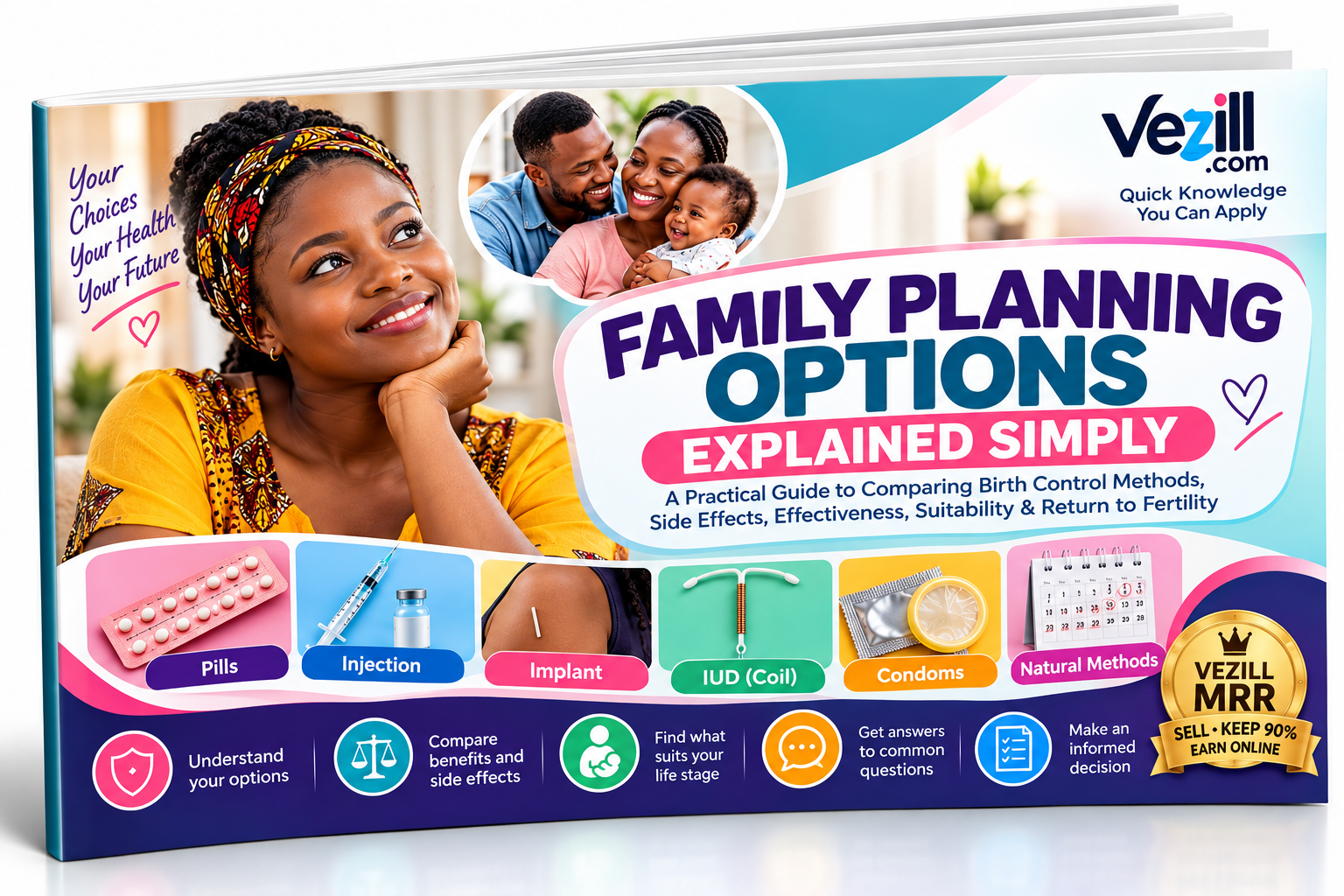
Family Planning Options Explained Simply helps you compare the major contraceptive methods, understand their benefits and trade-offs, know what questions to ask, and have a more informed conversation with a qualified healthcare professional.
It sounds like a simple question.
But the answer can depend on much more than choosing between the pill, injection, implant or coil.
You may be wondering:
Will family planning make me infertile?
Which family planning method has fewer side effects?
Will I gain weight?
Why am I bleeding after starting contraception?
Can I use an implant while breastfeeding?
Which is better for me — implant or injection?
What is the difference between a copper IUD and hormonal IUD?
Can I use an IUD if I have fibroids?
How soon can I get pregnant after stopping family planning?
These are reasonable questions.
And when you receive different answers from friends, social media, online forums and even people who have used the same method, choosing contraception can become stressful.
This guide helps you understand why experiences differ — and what current evidence actually says.
Choosing contraception can involve very personal concerns.
Maybe you want to avoid pregnancy now but definitely want children later.
Perhaps you recently had a baby and need to understand family planning while breastfeeding.
Maybe you have heavy periods or fibroids.
Perhaps somebody told you that the injection causes infertility.
Or you heard that the implant can “move around the body.”
Maybe you're worried about gaining weight, losing sexual desire or bleeding continuously.
The problem isn't simply lack of information.
It's knowing which information you can trust.
This guide takes the most important family-planning questions and explains them in straightforward language so you can separate:
COMMON SIDE EFFECTS
from
POSSIBLE BUT LESS COMMON EFFECTS
from
WARNING SIGNS THAT NEED MEDICAL ATTENTION.
Understand how the major contraceptive methods work, including:
Male/external condoms
Female/internal condoms
Combined contraceptive pills
Progestin-only pills
Family planning injections
Contraceptive implants
Copper IUD/coil
Hormonal IUD/coil
Emergency contraception
Fertility-awareness methods
Lactational amenorrhea method (LAM)
Tubal sterilization
Vasectomy
Instead of simply listing methods, the guide explains what using each option actually involves.
See the important differences more clearly.
Compare methods based on:
Effectiveness • Duration • Hormones • Bleeding Changes • STI Protection • Convenience • Provider Requirements • Return to Fertility
This makes questions such as implant vs injection or IUD vs implant much easier to understand.
Both are popular hormonal contraceptive options, but they aren't interchangeable.
The guide explains:
Implant
✓ Works for years depending on the product
✓ Extremely effective
✓ No daily pill
✓ Fertility can return rapidly after removal
✓ Irregular bleeding can occur
Injection
✓ No daily pill
✓ Private and convenient for many users
✓ Usually repeated every few months depending on formulation
✓ Bleeding patterns can change
✓ Some users experience weight changes
✓ Some injections, particularly DMPA, can delay return to fertility after the last dose
A delay in fertility returning is NOT the same thing as permanent infertility.
The guide explains this distinction clearly.
Many people simply call both methods “the coil.”
But they can affect your body differently.
Hormone-free
Can provide long-term contraception.
But periods can become heavier, longer or more painful, particularly after insertion.
Releases a progestin hormone.
Periods often become lighter over time, and some users eventually have little or no bleeding.
Both are highly effective reversible methods, but suitability depends on individual circumstances.
Understanding this difference can prevent you from making a decision based on somebody else's experience with a completely different type of IUD.
This is one of the biggest fears surrounding contraception.
The guide tackles it directly.
You'll understand the difference between:
Temporary pregnancy prevention
Temporary delay in fertility returning
and
Permanent contraception
You'll also see how fertility generally behaves after stopping:
Pills
Implants
IUDs
Injections
Condoms
And why discovering a fertility problem after previously using contraception does not automatically mean the contraception caused it.
Bleeding changes are among the most common reasons people become worried about contraception.
This guide explains:
And importantly:
Which contraceptive methods are commonly associated with each pattern?
You'll also learn when a bleeding change may be an expected contraceptive effect — and when it deserves medical assessment.
“Which family planning method doesn't cause weight gain?”
It's an extremely common question.
But the answer requires context.
The guide explains why weight changes are not identical across all hormonal methods or all users, why the injection—particularly DMPA—is often part of this discussion, and why individual responses can differ.
Instead of promising a mythical “zero-side-effect method,” the guide helps you understand the trade-offs.
Have fibroids or very heavy periods?
Don't simply copy somebody else's contraceptive choice.
Inside you'll understand:
What fibroids are
Whether contraception causes fibroids
Why fibroids can cause heavy bleeding
How contraception may affect bleeding
Why the size and location of fibroids matter
Why distortion of the uterine cavity can matter when considering an IUD
Why individual assessment is important
Plus practical questions you can take directly to your healthcare provider.
A common misconception is:
“I'm breastfeeding, so I can't get pregnant.”
Breastfeeding can suppress ovulation under specific conditions, but pregnancy can become possible before your first visible menstrual period returns.
The guide explains:
Postpartum pregnancy risk
Family planning after childbirth
Breastfeeding considerations
Lactational Amenorrhea Method (LAM)
Why LAM has specific criteria
Why contraceptive timing can differ after childbirth
Questions to discuss during postnatal care
Especially useful for new mothers who want to space pregnancies safely and intentionally.
Learn more about:
Spotting
Irregular periods
Missing periods
Heavy periods
Headaches
Nausea
Breast tenderness
Mood changes
Weight concerns
Acne and skin changes
Sexual desire concerns
Implant-site symptoms
Injection-site symptoms
The aim isn't to convince you that side effects don't happen.
It's to help you understand what may happen, why it may happen, and when you should speak to a healthcare professional.
The guide examines these fears individually and explains what current medical evidence indicates.
Because fear should not make your healthcare decisions for you.
Rather than telling everybody to use the same method, the guide helps you think through real-life priorities.
See methods worth discussing that require less frequent action.
Compare non-hormonal possibilities and their trade-offs.
Understand why return-to-fertility timing matters.
See why bleeding effects should be part of your decision.
Understand discreet contraceptive options.
Know what questions to discuss with your provider.
Understand why condoms remain different from most other contraceptive methods.
Learn about long-acting reversible contraception.
Before your appointment, identify:
How long do I want to prevent pregnancy?
Do I want children later?
Would remembering contraception every day be difficult?
Do I prefer hormonal or non-hormonal contraception?
Are my periods normally light, moderate, heavy or irregular?
Is STI protection important?
Is privacy important?
Am I breastfeeding?
What health conditions or medicines should I mention?
What is my biggest fear about contraception?
Then write down the questions you want answered.
Instead of walking into a clinic confused, you arrive better prepared to participate in the decision.
The guide gives you a practical consultation checklist, including:
How effective is this method?
What side effects should I realistically expect?
How might it change my periods?
How long will it work?
Can I stop whenever I want?
Who removes it?
How quickly can fertility return?
Does my medical history change its safety?
Does it interact with my medication?
Does it protect against STIs?
What warning signs should make me return to the clinic?
What are my alternatives?
Because informed consent means understanding what you're agreeing to.
When you don't want to reread the entire guide, use the quick-reference comparison to review:
Condom
Pill
Injection
Implant
Copper IUD
Hormonal IUD
Permanent contraception
Compare the major options across effectiveness, duration, hormones, periods, STI protection, fertility return, convenience and important considerations.
This practical guide may be particularly useful if you are:
✓ Considering family planning for the first time
✓ Trying to space your children
✓ Planning to avoid pregnancy for several years
✓ Considering an implant, injection, pill or IUD
✓ Worried about family planning side effects
✓ Concerned about future fertility
✓ Breastfeeding or recently gave birth
✓ Living with fibroids or heavy periods
✓ Looking for a hormone-free option
✓ Confused by conflicting advice online
✓ Preparing for a family-planning consultation
✓ A couple who wants to understand the available choices together
Online searches can give you dozens of disconnected answers.
One page explains implants.
Another discusses injections.
A social-media video warns about infertility.
A friend tells you her periods stopped.
Someone else says hers became heavier.
This guide brings the major questions together into one structured, easy-to-follow decision companion.
↓
↓
↓
↓
↓
↓
↓
↓
The guide directly addresses high-intent questions around:
Family planning methods
Family planning methods and side effects
Best family planning method
Birth control methods
Implant family planning
Family planning injection
Contraceptive pills
IUD contraception
Coil family planning
Family planning for breastfeeding mothers
Family planning after delivery
Family planning and infertility
Family planning and weight gain
Family planning and irregular periods
Family planning and fibroids
Implant vs injection
IUD vs implant
Family planning services in Kenya
So instead of giving you more information to sort through, it helps organize those questions into a practical decision process.
Your purchase can provide more than personal knowledge.
Where the product is sold with an eligible VEZILL Master Resell Rights licence, you can also become a digital-product reseller.
1. BUY
Purchase the guide with its applicable MRR licence.
↓
2. LEARN
Understand the product so you can market it responsibly.
↓
3. BECOME A VEZILL RESELLER
Activate or use your eligible reseller account according to VEZILL's current terms.
↓
4. SHARE
Promote the digital guide through channels such as WhatsApp Status, TikTok, Facebook, Instagram, short-form video or your audience.
↓
5. SELL
Customers purchase through your reseller link/process.
↓
Knowledge you can apply personally.
A digital product you may be able to resell for income.
*MRR eligibility, commission/revenue share, fees and reseller conditions are subject to the current VEZILL licence and platform terms. Earnings are not guaranteed and depend on sales.
Family planning isn't a one-time trend.
People continually search for answers about:
Implants.
Injections.
Pills.
IUDs.
Side effects.
Breastfeeding.
Periods.
Weight gain.
Fibroids.
Future fertility.
That creates an ongoing educational need.
For a reseller, the opportunity isn't to make exaggerated medical promises.
It is to connect people searching for understandable family-planning information with a structured educational resource.
You don't have to make a family-planning decision based solely on fear, rumours or another person's experience.
Understand your options.
Compare the trade-offs.
Know what questions to ask.
Understand what may happen to your periods.
Know what fertility return means.
Know which symptoms deserve medical attention.
Then have a better-informed conversation with a qualified healthcare professional.
Instant Digital Access
Practical Family Planning Comparison Guide
Printable Decision Worksheet
Myth vs Fact Explanations
Kenya-Relevant Service Guidance
VEZILL MRR Opportunity Where Included
Quick Knowledge You Can Apply.
This guide provides general educational information and does not diagnose medical conditions, prescribe contraception, or determine whether a specific contraceptive method is medically suitable for you.
Individual suitability can depend on your medical history, blood pressure, medications, breastfeeding/postpartum status, migraine history, blood-clot risk, unexplained bleeding and other factors.
Consult an appropriately qualified healthcare professional for individualized contraceptive advice, insertion/removal procedures, persistent or concerning side effects, and medical emergencies.
Get the updates, on newly released, popular & fast-moving MRR digital products
Up to Top
Comments