
Ellan
Joined - December 2025

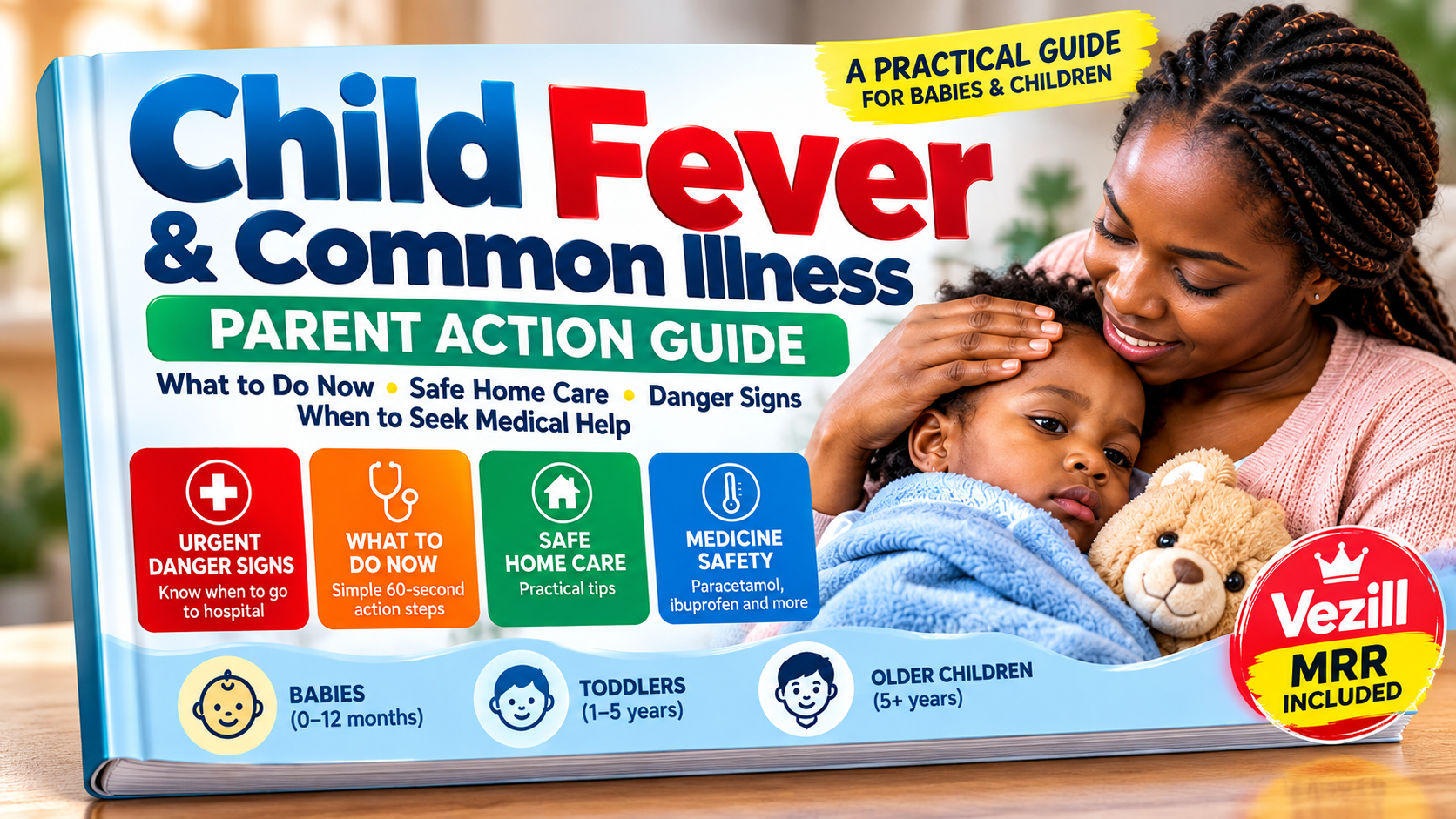
A practical parent action guide that helps you recognise danger signs, provide safe home care, monitor your child and know when medical attention is needed.
Your child feels unusually hot.
The thermometer shows a fever.
Maybe they are coughing. Maybe they are vomiting, refusing food, sleeping more than usual—or the fever keeps returning.
And suddenly you have dozens of questions:
Is this fever dangerous?
Should I take my child to hospital?
How can I safely reduce the fever?
What temperature is too high for a toddler?
Can I give paracetamol or ibuprofen?
What if my child has fever and cough?
Could it be malaria?
What if my child has a seizure?
When your child is sick, you don't want to spend hours searching Google, watching videos and comparing conflicting advice.
You want to know:
That is exactly what the Child Fever & Common Illness: Parent Action Guide is designed to help you understand.
This is not another long medical textbook.
It is a practical, easy-to-follow parent action guide designed to help you quickly understand what to check when a baby, toddler or older child develops fever or common illness symptoms.
Inside, you'll learn how to look beyond the thermometer and check the things that can matter even more:
Age • Breathing • Alertness • Drinking • Breastfeeding • Urination • Vomiting • Rash • Seizures • Other symptoms
So instead of panicking over one temperature reading, you can make a more informed decision about the next step.
This is one of the biggest questions parents have.
The guide gives you a simple 60-Second Fever Action Plan.
You learn to check:
Fever requires different levels of concern depending on whether your child is a young baby, older infant, toddler or older child.
Learn how to measure your child's temperature more reliably instead of relying only on touching their forehead.
Learn which symptoms should make you stop home monitoring and seek urgent medical attention.
Is your child breathing comfortably or are they breathing unusually fast or struggling?
Are they drinking or breastfeeding?
Are they still urinating?
Could they be becoming dehydrated?
Can you wake and interact with your child normally?
Are they unusually sleepy, confused or unresponsive?
Cough?
Vomiting?
Diarrhoea?
Rash?
Ear pain?
Seizure?
Possible malaria exposure?
You then use the guide's simple action system to understand whether the situation points toward:
🟢 Monitor & Safe Home Care
🟠 Get Medical Advice / Assessment
🔴 Seek Urgent Medical Attention
One of the most valuable things a parent can learn is not simply how to reduce a temperature, but how to recognise when a sick child may need urgent medical care.
The guide explains important warning signs including:
Severe difficulty breathing
Blue or grey lips/skin
A child who is very difficult to wake
Markedly reduced responsiveness
Seizures or convulsions
Stiff neck
A concerning rash that doesn't fade with pressure
Inability to drink or breastfeed
Repeated vomiting
Signs of severe dehydration
Rapid worsening of the child's condition
Current Kenyan clinical guidance also emphasizes the importance of respiratory distress and feeding problems in sick children, particularly very young infants.
A fever does not mean exactly the same thing at every age.
That's why this guide includes a dedicated:
Covering:
👶 Young babies
👶 Babies under 3 months
🍼 3–6 months
🍼 6–12 months
👧 1–2 years
🧒 2–5 years
👦 Older children
You'll learn which age groups require additional caution and which symptoms should prompt medical assessment.
For example, fever in a very young baby deserves particular attention.
Instead of giving you random internet remedies, the guide explains practical supportive care.
Learn about:
✓ Fluids and hydration
✓ Breastfeeding during illness
✓ Appropriate clothing
✓ Rest
✓ Monitoring temperature
✓ Checking urine output
✓ Keeping medicine records
✓ What fever medicine actually does
✓ Practices to avoid
Most importantly, you'll understand why the goal isn't simply to force the thermometer back to a “normal” number.
How your child looks, breathes, drinks and responds matters too.
One of the most stressful questions for parents is:
The guide includes a dedicated Medicine Safety section explaining:
Paracetamol/acetaminophen
Ibuprofen
Why children's doses should not be guessed
Why your child's weight matters
Why medicine concentration matters
Why kitchen teaspoons shouldn't be used for measuring medicine
Why duplicate medicines can be dangerous
Why medicines shouldn't automatically be alternated
Why aspirin should not routinely be given to children for fever
The guide helps you understand what information you need to check on the medicine label or confirm with a clinician/pharmacist.
Parents frequently worry about fever accompanied by coughing.
The guide shows you what to observe:
✓ Is breathing unusually fast?
✓ Is the child working hard to breathe?
✓ Is the chest pulling inward?
✓ Is there grunting or wheezing?
✓ Can the child drink comfortably?
✓ Is the child's colour changing?
✓ Is the child unusually sleepy?
Kenya's current primary-care clinical guidance treats respiratory distress and feeding difficulty as important assessment features in children.
The immediate concern can quickly become dehydration.
Learn how to monitor:
Drinking
Breastfeeding
Urination/wet nappies
Dry mouth
Tears
Alertness
Vomiting
Diarrhoea
The guide also explains the role of oral rehydration solution (ORS) and when vomiting or diarrhoea requires medical assessment.
Not every rash means the same thing.
Learn:
✓ What to observe
✓ Why a rash cannot diagnose an illness by itself
✓ What a non-fading rash means
✓ Which accompanying symptoms increase concern
✓ When fever + rash needs urgent medical attention
This can be one of the most frightening experiences for any parent.
The guide includes a highly visible:
action page.
Learn basic first-aid principles, including:
✓ Protecting your child from injury
✓ Safe positioning
✓ Timing the seizure
✓ Why you should never put anything into the child's mouth
✓ Why you shouldn't restrain the child
✓ When emergency medical help is needed
For parents in Kenya and other malaria-endemic regions, this is an important question.
The guide explains possible malaria symptoms such as fever, chills, headache, vomiting and weakness—
but importantly explains why:
Symptoms alone cannot reliably confirm malaria.
The guide explains the importance of malaria testing and recognising severe illness rather than automatically treating every fever as malaria.
A child develops a fever.
Many parents immediately wonder:
“Does my child need antibiotics?”
The guide explains why:
You'll understand:
✓ Bacterial vs viral infections
✓ Why antibiotics don't treat viruses
✓ Why leftover antibiotics shouldn't be reused
✓ Why another child's antibiotics shouldn't be shared
✓ Why unnecessary antibiotic use contributes to antimicrobial resistance
Few situations create more anxiety than waking during the night and finding your child burning hot.
So the guide includes a dedicated:
decision page.
Quickly review:
🔴 Seek emergency help now if...
🟠 Seek prompt medical assessment if...
🟢 Home monitoring may be reasonable if...
Instead of making the decision from the temperature alone, you'll know what else to check.
You'll get practical guidance covering:
✓ 60-Second Fever Action Plan
✓ Understanding Childhood Fever
✓ How to Measure Temperature
✓ Fever Guidance by Age
✓ Emergency Danger Signs
✓ Safe Home Care
✓ Paracetamol & Ibuprofen Safety
✓ How to Safely Manage Fever Discomfort
✓ Fever + Cough
✓ Breathing Problems
✓ Fever + Runny Nose
✓ Fever + Sore Throat
✓ Fever + Vomiting
✓ Fever + Diarrhoea
✓ Dehydration Warning Signs
✓ Fever + Rash
✓ Fever + Ear Pain
✓ Fever + Seizure
✓ Fever With No Obvious Symptoms
✓ Malaria in Children
✓ Common Childhood Illnesses
✓ Antibiotics Explained
✓ Fever After Vaccination
✓ Fever at Night
✓ Fever Myths vs Facts
✓ Green/Amber/Red Action System
✓ “Should I Go to Hospital?” Checklist
✓ Clinic Preparation Checklist
✓ Child Medicine Record
✓ Fever Monitoring Log
✓ Final 60-Second Action Card
When your child has a fever, you don't need twenty browser tabs open.
You need important information arranged around the questions you're actually asking:
That's the problem this guide is designed to solve.
Because fever often happens unexpectedly.
At night.
During weekends.
While travelling.
When you're alone with your child.
Or when you're simply unsure whether what you're seeing is normal.
Having a structured action guide available means you can quickly check the important questions instead of trying to remember everything while worried.
You don't need medical training.
The guide uses:
✓ Simple language
✓ Step-by-step instructions
✓ Quick-reference boxes
✓ Practical checklists
✓ Traffic-light warnings
✓ Age-based guidance
✓ Medicine safety reminders
✓ Printable monitoring tools
✓ Phone-friendly pages
It is designed for parents and caregivers of:
Babies • Toddlers • Preschool Children • Older Children
The guide includes practical record pages you can use when your child becomes ill.
Record:
Date | Time | Medicine | Concentration | Dose | Temperature | Who Gave It
This can help reduce accidental duplicate doses when more than one caregiver is looking after the child.
Track:
Temperature | Drinking | Urination | Breathing | Alertness | Symptoms | Action Taken
You can also take this information with you when seeking medical care.
The guide's framework draws on established child-health guidance, including:
Kenya Ministry of Health
World Health Organization IMCI principles
Established paediatric guidance
The emphasis is deliberately placed on danger signs and the child's overall condition, not simply the thermometer reading.
Keep the PDF on your phone and refer to it when your child develops fever or common illness symptoms.
Your purchase also includes the VEZILL Master Resell Rights (MRR) opportunity, subject to the applicable VEZILL licence terms.
That means this isn't only practical knowledge you can use - it can also become a digital product you promote and resell.
With the applicable MRR licence, you can:
✓ Purchase the product
✓ Learn from the guide
✓ Promote the digital product
✓ Resell it according to the licence terms
✓ Earn 90% from qualifying sales
This creates a simple model:
Instead of purchasing knowledge that stops with you, MRR gives you an opportunity to turn useful digital knowledge into a resellable digital asset.
This guide is particularly useful for:
Parents of babies and toddlers
First-time parents
Expectant parents preparing for childcare
Grandparents
Babysitters
Nannies
Child caregivers
Families with young children
Anyone responsible for looking after a child
And with MRR included, it can also appeal to:
Digital product resellers
Parenting-content creators
Online marketers
Social-media sellers
VEZILL resellers
You cannot predict when your child will become sick.
But you can be better prepared.
Instead of asking:
“What do I do?”
know what to check.
Instead of judging illness by temperature alone,
know the warning signs.
Instead of guessing about medicine,
know what information matters.
Instead of wondering whether to wait,
know when professional medical assessment is needed.
Instant Digital PDF Access
Parent-Friendly
Kenya-Relevant
Quick-Reference Action Tools
VEZILL MRR Included
This guide provides general educational information for parents and caregivers. It does not diagnose illness or replace professional medical assessment. Babies and children can deteriorate quickly. If your child has emergency warning signs, appears seriously unwell, or you are concerned about their condition, seek qualified medical care promptly.
Get the updates, on newly released, popular & fast-moving MRR digital products
Up to Top


Comments